
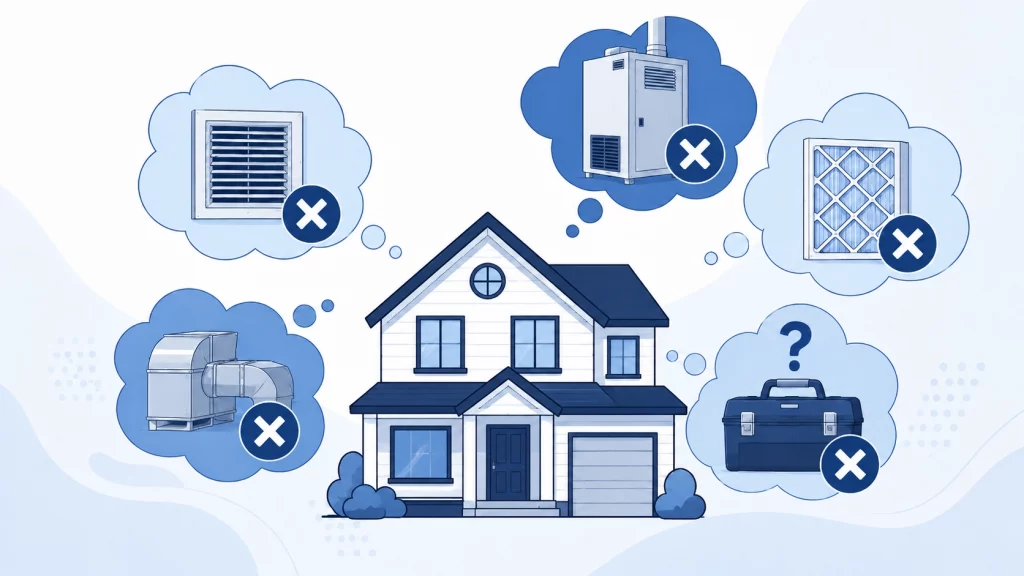
Closing vents doesn’t save energy, it strains your blower and can freeze coils. Bigger systems don’t cool or heat better, they short-cycle and wear out faster. Filters need changing every 1-3 months, not once a year. Duct cleaning rarely fixes hot and cold spots, duct design usually does. And not all HVAC contractors have the same experience with older homes. Here’s what actually works instead.
We’ve heard some interesting HVAC advice over 20+ years in the field. Some of it’s solid. Some of it is costing you money every month. Let’s clear up the confusion.
Myth #1: “Closing Vents in Unused Rooms Saves Money”
What Homeowners Think
If you’re not using a bedroom or spare room, closing the vent means your furnace or AC doesn’t have to heat or cool that space. Less work for your system should mean lower bills.
The Reality
This actually damages your system and can cost you more money. Your furnace and air conditioner are designed to move a specific amount of air through your ductwork. Closing vents doesn’t reduce the workload, it creates pressure problems that force your system to work harder.
Closed vents increase air pressure in your ducts. That extra strain increases energy consumption and shortens the life of your equipment.
Here’s What Happens
The reduced airflow can cause your heat exchanger to overheat or your AC coils to freeze. Both lead to expensive repairs.
What Actually Works
Leave all vents open. If specific rooms are uncomfortable, the issue is probably poor duct design, inadequate insulation, or an improperly sized system, all fixable problems that closing a vent won’t solve. If you genuinely need different temperatures in different areas, consider a zoned system or mini-splits designed for that purpose.
Myth #2: “Bigger HVAC Systems Cool and Heat Better”
What Homeowners Think
If a 3-ton AC struggles to cool your house, a 5-ton unit will solve the problem. More capacity should mean better performance.
The Reality
Oversized systems create comfort problems and waste energy. A system that’s too large for your home cycles on and off too frequently. It reaches temperature quickly, shuts down, then kicks back on a few minutes later. This constant cycling prevents proper dehumidification in summer and creates temperature swings.
Here’s What Happens
Short cycling wears out components faster. Your compressor, blower motor, and other parts experience more stress from frequent starts and stops than from continuous operation. You also pay more, since oversized equipment costs more upfront and uses more energy per cycle, even if it runs for shorter periods.
In summer, inadequate dehumidification leaves your home feeling clammy even when the temperature seems right. Many homeowners crank the thermostat lower trying to feel comfortable, wasting even more energy.
What Actually Works
Proper sizing based on your home’s square footage, insulation levels, window efficiency, air leakage, and layout. A qualified contractor should perform a load calculation, not just guess based on square footage.
If you do need to replace an oversized or aging system, check current furnace and AC rebates available to Canadian homeowners before you budget for the upgrade.
Especially True for Older Homes
For homes built between 1970 and 1999, this calculation matters even more. Insulation standards, ductwork design, and construction methods differ significantly from modern homes. What works in a new build won’t work the same way in an older bungalow.
Myth #3: “You Only Need to Change Your Filter Once a Year”
What Homeowners Think
The filter lasts a long time, so annual replacement during your furnace tune-up should be sufficient.
The Reality
Most filters need changing every 1-3 months, depending on your home. A clogged filter forces your system to work harder to pull air through, which increases energy consumption, reduces efficiency, and can cause your system to overheat or freeze up.
Here’s What Happens
Restricted airflow from a dirty filter means less heated or cooled air reaches your rooms, so your system runs longer to maintain temperature, driving up energy bills. Dirt that bypasses a saturated filter circulates through your home and settles on coils and other components, reducing efficiency further and potentially causing mechanical failures. Chronic dirty filters are one of the most common causes of preventable HVAC problems we see.
What Actually Works
Check your filter monthly. If it looks dirty or clogged, replace it. How often you actually need to change it depends on a few factors:
- Pets in the home: monthly changes typically needed
- Allergies or asthma: every 1-2 months
- Ongoing renovations: monthly or more often
- Average home, no special factors: every 2-3 months
Set a reminder for the first of each month. Walk over, pull out the filter, and look at it. Takes two minutes. Replace it if needed, and write your filter size on your calendar or take a photo of the label so you’re not guessing at the hardware store.
Myth #4: “Duct Cleaning Solves All Airflow Problems”
What Homeowners Think
If rooms are too hot or too cold, dirty ducts must be blocking airflow, and cleaning them should fix everything.
The Reality
Duct cleaning is often unnecessary and rarely solves comfort problems. Most airflow issues stem from duct design, not dirt. Undersized ducts, missing return vents, poorly placed supply registers, or leaking connections cause the vast majority of hot and cold spots we find.
Here’s What Happens
Companies offering low-cost whole-house duct cleaning often upsell aggressive treatments you don’t need, or find “problems” that don’t actually exist, while your real issues go unaddressed. Health Canada, EPA (in the States) and even CMHC all agree that duct cleaning has never been shown to prevent health problems. Ducts get dusty, but unless you have visible mold growth, vermin infestation, or substantial dust actually clogging ducts, cleaning doesn’t help.
What Actually Works
If you have comfort problems, start with a proper assessment of your duct system:
- Are ducts properly sized for your equipment?
- Do you have adequate return air on each floor?
- Are supply vents positioned to effectively distribute air?
- Are there visible leaks or disconnected sections?
- Is attic or basement ductwork insulated?
These are the issues that actually affect comfort. They require different solutions than cleaning, but they’re fixable. Save your money unless you have a specific documented reason for duct cleaning, such as post-renovation construction debris or verified mold.
Myth #5: “All HVAC Contractors Are the Same”
What Homeowners Think
HVAC work is straightforward. Any licensed contractor can handle your furnace or AC installation. Just get three quotes and pick the middle one.
The Reality
Specialization matters, especially for older homes. A contractor who primarily works on new construction won’t necessarily understand the challenges of a 1970s home. The ductwork was designed for different equipment, insulation standards were lower, and wall cavities, ceiling heights, and mechanical room layouts differ from modern builds.
Here’s What Happens
We regularly see installations done by contractors who treated an older home like new construction. Undersized ductwork gets connected to oversized equipment. Mini-splits get installed without considering how old homes lose and gain heat. Renovations proceed without anyone checking whether existing HVAC can handle the additional square footage. The result is uncomfortable rooms, high energy bills, and expensive do-overs.
What Actually Works
Contact us and put us to the test. We’re experienced, our staff will answer all your questions and we’re happy to walk you through exactly how we approach load calculations, duct modifications, and older-home quirks before you commit to any project.
Here are some questions you can ask our team:
- How many pre-2000 homes have you worked on?
- Can you show examples of older home projects?
- Do you perform load calculations, or just estimate based on square footage?
- How do you handle duct modifications in finished spaces?
- What’s your approach to adding AC in a home without existing ductwork?
The Common Thread
Notice what these myths have in common? They’re all shortcuts that seem logical but ignore how HVAC systems actually work.
Your home is a system. Heating, cooling, insulation, air sealing, and ventilation all work together. Change one element without understanding the others, and you create new problems.
The good news is that once you understand what actually works, most HVAC decisions become straightforward. Focus on proper sizing, adequate airflow, regular maintenance, and working with contractors who understand older homes.
What You Should Actually Do
For Immediate Savings
- Check your filter monthly and replace when dirty
- Keep all vents open
- Clear furniture and curtains away from vents and returns
- Set your thermostat to reasonable temperatures: 20-22°C in winter, 24-26°C in summer
- Use ceiling fans to improve air circulation
For Long-Term Comfort
- Have your furnace and AC serviced annually by someone who specializes in older homes
- Address insulation and air sealing before replacing equipment
- Get proper load calculations before any equipment replacement
- Fix duct design issues rather than accepting poor comfort
- Replace equipment at 15-20 years old, not sooner unless it’s failing
Before Any Renovation
- Talk to your HVAC contractor before finalizing layouts
- Verify your system can handle additional square footage
- Check duct routing before moving walls
- Add return air if you’re adding bedrooms or finishing basements
- Consider whether your renovation timeline aligns with equipment replacement needs
Questions About Your Specific Home?
Every home is different. A 1975 bungalow has different needs than a 1990 two-story. Your insulation, ductwork, equipment age, and comfort priorities all factor into the right solutions for your situation.
We’re happy to take a look. We’ve worked on hundreds of older homes and know what works and what’s a waste of your money. No pressure, just straight answers about what your home actually needs.
Not Sure Which of These Applies to Your Home?
Give us a call and we’ll walk through what’s actually going on with your system, no guesswork.
Call Us: 905-845-4009
In This Article
Questions? We can help.
Atlantis HVAC Systems Inc.
905-845-4009 | Contact Us